
.svg)
Home Health Care for ALS in Chicago
APEX Health Services supports patients and families managing amyotrophic lateral sclerosis (ALS) through home health care built around the pace of the disease. Our clinical team works closely with neurologists, pulmonologists, and other specialists so that mobility, speech, swallowing, and breathing needs are addressed as they change, rather than after a crisis occurs.
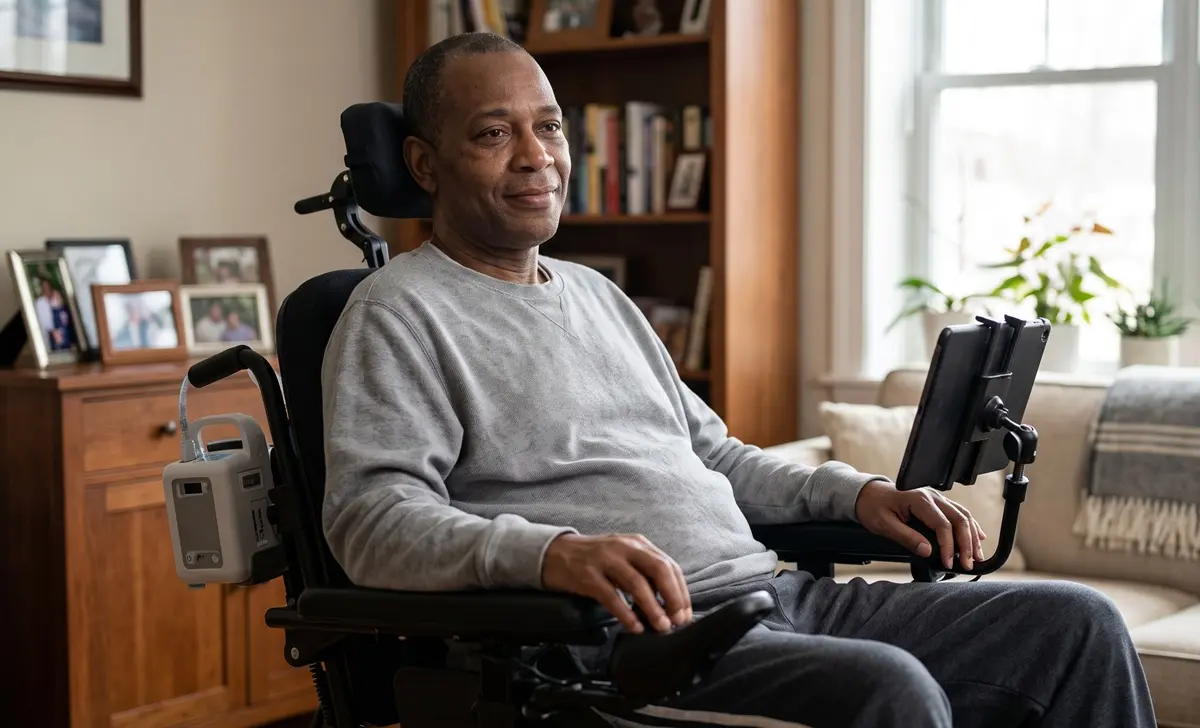


Specialized Home Health Care for ALS in Chicagoland
ALS can make it harder to move, speak, swallow, or breathe as the disease progresses. That doesn't mean giving up daily life. With the right care in place at home, people with ALS can stay safer, maintain their independence longer, and remain connected to the routines and people that matter most.
APEX Health Services provides specialized home health care for people living with ALS in Chicago and the surrounding suburbs. Our team builds a personalized care plan to help you maintain strength and mobility, support breathing and swallowing, and preserve your ability to communicate for as long as possible.

How ALS Progresses, and Why No Two Cases Match
Amyotrophic lateral sclerosis, sometimes called Lou Gehrig's disease, damages the nerve cells that carry signals from the brain to voluntary muscles, as the National Institute of Neurological Disorders and Stroke explains in its ALS overview. As those motor neurons break down, strength fades in a pattern that looks different from one patient to the next.
ALS falls under a broader category called motor neuron disease, and it is the most common form by far. APEX focuses its home health care specifically on ALS rather than taking a one-size-fits-all approach to every motor neuron diagnosis. About two in three patients notice weakness in an arm or leg first: a foot that drags, a hand that won't close around a doorknob. The other third notice their speech or swallowing change first, with limb weakness usually following within a year or two.
No two timelines are identical. Some people keep working and driving for years after diagnosis; others lose the ability to walk within months. APEX builds each amyotrophic lateral sclerosis care plan around whichever pattern the patient is living through.
The First Signs of ALS Most Families Notice at Home
ALS rarely shows up all at once. Often it's one small thing (a dropped fork, a word that comes out thick) long before anyone says the words "amyotrophic lateral sclerosis" out loud.
Grip strength for buttons, jars, or a toothbrush.
A foot that drags or catches on stairs and curbs.
Speech that's quieter or harder to understand.
Meals that trigger coughing or take longer than they used to.
Shortness of breath lying flat or climbing stairs.
Muscle twitches and cramping, often worse at night.
What Causes ALS, and Who's Most at Risk
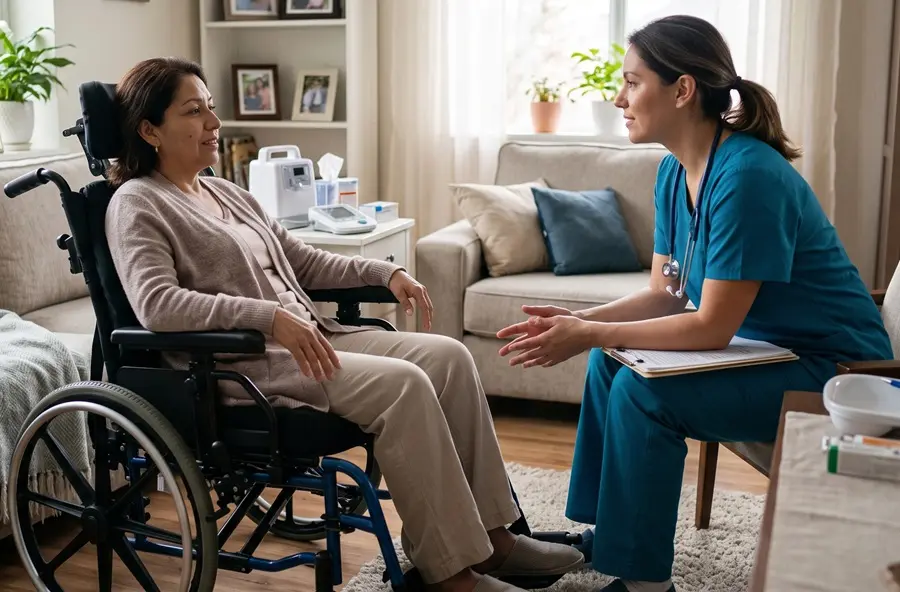
Doctors usually can't identify a single cause for most patients. Somewhere between 90 and 95 out of every 100 cases are sporadic, meaning they show up with no family history and no clear trigger, according to CDC ALS registry data. Researchers suspect a combination of genetic susceptibility and environmental exposure, though no single factor explains the disease on its own.
The remaining 5-10% are familial, tied to specific inherited gene mutations such as SOD1. A family history raises risk, and diagnosis is somewhat more common in men, usually after age 60, though ALS can appear earlier.
No blood test or scan confirms ALS on its own. Neurologists typically use nerve and muscle testing to rule out other conditions before confirming an ALS diagnosis.
Signs It's Time for Home Health Care for ALS
Many families wait, hoping strength will come back or a new medication will change the picture. With ALS, the better question is whether the home still fits what the body can do right now.
A fall, near-fall, or new unsteadiness on stairs.
More than one or two meals that end in choking or coughing.
Speech that even close family struggles to follow.
Weight loss with no clear explanation.
A recent hospital stay for breathing trouble or pneumonia.
What Can Happen When ALS Care Is Delayed
ALS progresses regardless of how care at home is arranged, but the way a household responds can shape how that progression affects daily life.
More frequent falls as leg strength and balance decline.
Poor nutrition or dehydration when swallowing trouble goes unmanaged.
Aspiration pneumonia from food or liquid reaching the airway.
Pressure sores in patients who can no longer shift position on their own.
Respiratory emergencies that earlier monitoring could have caught.
Caregiver exhaustion, since ALS care often lands on one or two family members.
Bring the Support Home Before the Crisis
APEX coordinates home health care for ALS patients across Illinois, matched to the current stage of the illness.
What APEX Brings into the Home for Amyotrophic Lateral Sclerosis
Skilled Nursing That Catches Changes Early
Because ALS doesn't sit still, skilled nursing visits check strength, breathing effort, weight, and skin condition every time, not just one symptom. An early catch gives the care team, along with the patient's neurologist, time to respond before the problem becomes an ER visit.
Respiratory Care Before Breathing Becomes a Crisis
The muscles that control breathing weaken along with everything else in ALS, often before the patient notices. APEX works with pulmonology and respiratory therapy to track lung function and introduce equipment such as non-invasive ventilation when needed, not after a crisis forces the issue.
Speech and Swallowing Support That Lasts Longer
When words or swallowing start slipping, speech-language pathologists step in to slow the loss of both. That might mean exercises to maintain speech clarity, techniques to reduce choking risk at meals, or a communication device introduced while speech is still strong enough to use it effectively.
Physical and Occupational Therapy to Stay Independent
Physical therapy keeps joints moving and muscles as strong as ALS allows, which helps push back the stiffness that comes from sitting still. Occupational therapy reshapes the home itself: grab bars, adapted utensils, transfer techniques, so patients keep handling as much as their bodies still allow.
Equipment and Nutrition: One Less Thing to Manage
A medical social worker or care coordinator helps sort out the equipment ALS eventually calls for: wheelchairs, hospital beds, feeding tube supplies if swallowing turns unsafe, communication devices. APEX also tracks nutrition as chewing and swallowing change, bringing in a dietitian if weight loss becomes a concern.
Our ALS Care Process
Referral Benefits Verification Care Plan
APEX starts with the neurologist's notes, current medications such as riluzole, and recent test results, then connects directly with the specialist already managing the patient's ALS.
Coverage Confirmed First
Our team checks what Medicare, Medicaid, or private insurance will cover before the first visit happens, so the family knows where costs stand and where a waiver program might help.
Home Visit and Plan
A clinician comes to the home to see how the patient is navigating the day (stairs, the bathroom, mealtime) and builds the plan around that, with room to change it as ALS changes the picture.
Does Insurance Cover ALS Care at Home?
Medicare, Medicaid, and most private insurance plans cover home health services for ALS once a physician orders them and documents medical necessity, the same way they treat other progressive neurological conditions, under Medicare's home health coverage rules. Illinois Medicaid waiver programs often reach further into non-medical support and equipment than private insurance typically does. APEX handles benefit verification and prior authorization before care starts, so the clinical conversation isn't held up by paperwork.

Why APEX Builds ALS Care Plans That Change with the Disease
APEX builds ALS care plans that adjust as strength, speech, and breathing change, working directly with each patient's neurologist and pulmonologist to ensure the plan evolves with the disease. APEX also supports Illinois families managing other progressive neurological conditions, including multiple sclerosis home care.
The Specialists Behind APEX's ALS Care
.jpg.webp)

Where APEX Provides ALS Care in Illinois
APEX Health Services provides home health care for ALS patients throughout Illinois, including Chicago, its surrounding suburbs, and much of northern and central Illinois.
McHenry County
Lake County
Kane County
Will County

DuPage County
Cook County
Kendall County
.webp)
Contact APEX to Start ALS Care at Home
Contact APEX Health Services to talk through symptoms, current specialists, and what home health care for amyotrophic lateral sclerosis could look like for your family.

FAQ
When should someone with amyotrophic lateral sclerosis start home health care?
There's no single right week to begin. Care can start with a home safety and mobility assessment soon after diagnosis, then scale up as strength, speech, or breathing change, so families don't need to wait for a crisis to request an evaluation.
Does APEX only step in once ALS reaches a late stage?
No. Home health care for ALS can start right after diagnosis, sometimes as light as physical therapy and monitoring, then grow to include respiratory support, feeding help, or full personal care as needs increase.
Can home health care for ALS include help with breathing?
Yes. APEX coordinates non-invasive ventilation, oxygen therapy, and respiratory monitoring with the patient's pulmonologist as breathing muscles weaken.
What happens once speech is too affected for normal conversation?
Speech-language pathologists working with APEX can introduce communication boards or speech-generating devices while speech is still functional, so the patient has a reliable way to express their needs and preferences as the disease progresses.
How closely does APEX work with a patient's neurologist?
Our clinical team stays in direct contact with the treating neurologist and any other specialists involved, including pulmonology, nutrition, and palliative care, so the in-home plan aligns with the same goals established during hospital or clinic visits.
What Families Say About APEX Care
Our Nurse, Amy, was wonderful, an angel to my mother and our family. Our hospice team made a very difficult time in our lives, a little easier.
Melody is the best nurse I have ever had, and I have had a lot throughout my illness. We would not be alive today without her help when we had COVID.
Melody is the best nurse I have ever had, and I have had a lot throughout my illness. We would not be alive today without her help when we had COVID.
Melody is the best nurse I have ever had, and I have had a lot throughout my illness. We would not be alive today without her help when we had COVID.
Our Nurse, Amy, was wonderful, an angel to my mother and our family. Our hospice team made a very difficult time in our lives, a little easier.
Melody is the best nurse I have ever had, and I have had a lot throughout my illness. We would not be alive today without her help when we had COVID.